
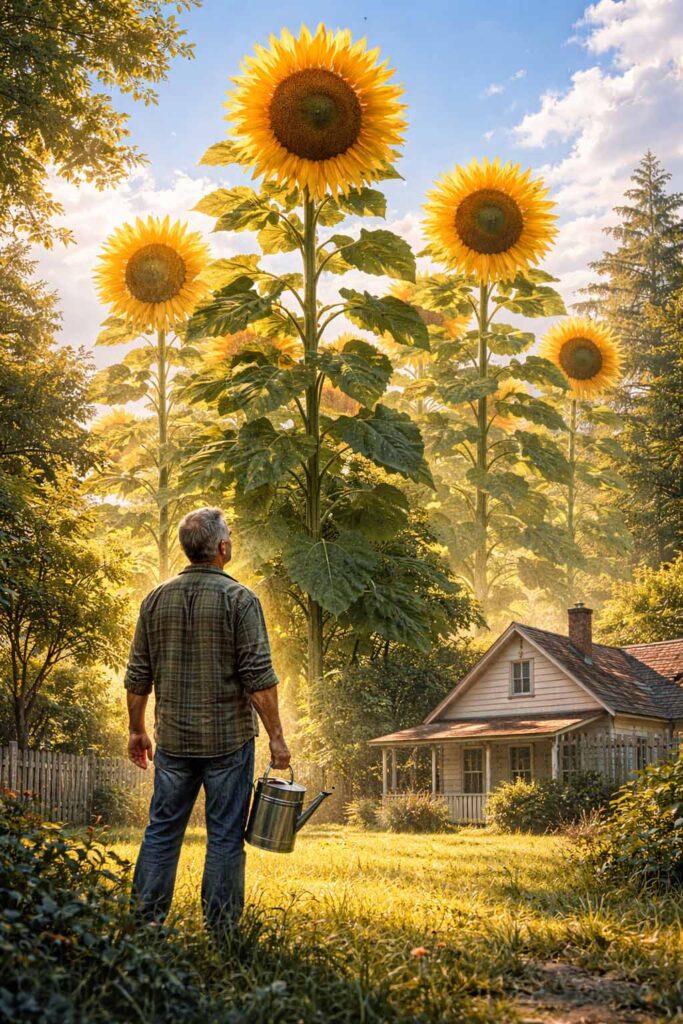
Douglas Keith Brynes planted the first sunflower without much thought.
It was early spring, the kind of morning where the soil still held the night’s cold, and the yard looked ordinary—modest trees, a leaning fence, nothing worth remarking on. Douglas pressed the seed into the earth with his thumb, brushed the dirt flat, and moved on with his day. But something about that act lingered, as if the ground had been listening.
The sunflowers rose fast.
At first, Douglas greeted them the way anyone would: with mild surprise and a bit of pride. Their stems thickened, their leaves widened, and their faces tracked the sun with unwavering devotion. By midsummer, they stood taller than Douglas himself. Neighbors slowed as they passed, glancing over the fence with puzzled expressions.
By late summer, the sunflowers had surpassed the trees.
They did not bend or bow. They climbed. Their stalks grew woody and strong, lifting massive golden heads high above the oak and maple branches, casting long, wandering shadows across the yard. The trees, which had stood there for decades, seemed suddenly uncertain of their place.
Douglas spent his evenings sitting in a lawn chair, watching the sunflowers sway. He felt no fear, only a strange, steady calm. The flowers creaked softly in the wind, a sound like old ships at harbor. Birds nested among the leaves, and bees vanished into the dense spirals of seed as if entering another world.
People began to talk.
Some said Douglas had used special fertilizer. Others claimed the soil was cursed or blessed, depending on who you asked. A man from town came by with a measuring tape and left shaking his head. The tallest sunflower rose higher than the roof of Douglas’s house, its face turned eternally skyward, as though it were studying something far beyond the clouds.
Douglas never corrected anyone. He watered the plants in the early morning and again at dusk, speaking to them quietly as he worked. He told them nothing important—just observations about the weather, the way the light fell, how fast the days seemed to move now. The sunflowers listened. They always listened.
As autumn approached, the flowers stopped growing. Their heads grew heavy with seeds, and their once-bright petals deepened to amber and rust. The trees below them dropped their leaves, exposing branches that looked thin and fragile by comparison.
One morning, after the first frost, Douglas noticed that the sunflowers had begun to lean. Not falling—resting. Their work, it seemed, was finished. They had reached as high as they could, and that was enough.
Douglas harvested the seeds carefully, filling jars and sacks. He left the towering stalks standing through winter, monuments against the snow. When spring returned, he cut them down and returned them to the soil.
The yard looked ordinary again.
But sometimes, when the sun hit the trees just right, Douglas could swear they stood a little taller than they used to—as if they remembered what it felt like to reach for something higher.